The Quiet Power of Neighborhood Medicine: Why Proximity Changes Health Outcomes
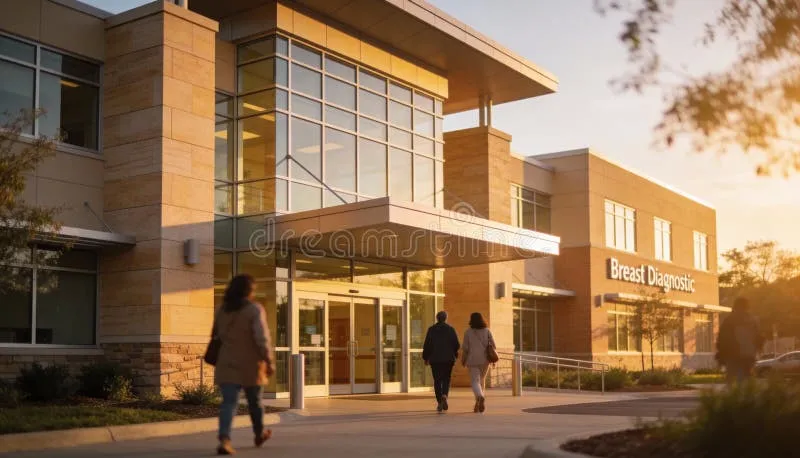
Photo: small neighborhood medical clinic exterior with patients walking on sunny street, via thumbs.dreamstime.com
There is a phrase that appears on clinic websites across the country — compassionate care, close to home — so often that it risks becoming invisible. We would like to make the case that it should not. The distance between a patient and their doctor turns out to be one of the most underestimated variables in American health, and the evidence suggesting that proximity changes outcomes is stronger than most people realize.
Distance Is a Determinant of Health
Public health researchers have long cataloged the social determinants of health: income, education, housing, food access. Transportation and geographic access belong on that list. Studies of rural and underserved urban populations consistently show that patients living farther from primary care are less likely to receive timely screenings, more likely to delay care until conditions become acute, and more likely to rely on emergency departments for problems that a routine visit could have managed.
Consider a working parent in a suburb without reliable transportation. A primary care appointment forty minutes away is not merely inconvenient; it may require rearranging a shift, arranging childcare, and burning half a day. When care is eight minutes from home, the calculus changes entirely. The appointment that would have been postponed simply gets kept.
Adherence Lives in the Details of Daily Life
Treatment plans do not fail in exam rooms; they fail in the weeks afterward, in the friction of daily life. A blood pressure medication that requires a follow-up visit across town is more likely to lapse than one managed by a provider down the street. Research on appointment adherence repeatedly finds that travel time and scheduling burden are among the strongest predictors of missed visits — stronger, in many cases, than the patient's own motivation.
This is the quiet argument for neighborhood medicine. When the clinic is embedded in the community, follow-up becomes ordinary. Patients stop by on their way home from work. A parent brings a child for a vaccination between school and dinner. Care stops being an event that must be planned and becomes a habit that simply happens.
Trust Is Built on Familiarity
There is a second, less measurable benefit: continuity of relationship. In a community clinic, patients tend to see the same faces — the same physician, the same nurses, the same front-desk staff who know their name and their history. Studies of continuity of care associate it with lower hospitalization rates, better chronic disease control, and higher patient satisfaction.
Trust, in medicine, is not decorative. A patient who trusts their provider discloses symptoms earlier, follows recommendations more faithfully, and asks the questions they might otherwise suppress. That trust is difficult to manufacture in large, rotating institutional settings. It grows naturally in places where the provider lives in the same community, shops at the same grocery store, and understands — without explanation — what it means to miss a shift at the local plant or juggle three part-time jobs.
What the Satellite Model Gets Right
Critics sometimes describe satellite clinics as a stripped-down version of real medicine. The evidence suggests the opposite. When a neighborhood clinic is connected to a larger hospital network — shared records, seamless referrals, coordinated specialty care — patients receive something neither a standalone practice nor a distant medical center can offer alone: intimacy at the point of contact, backed by depth behind the scenes.
We believe this hybrid is where American primary care is headed. Hospital systems are investing in community sites not merely to capture market share, but because keeping people well close to home is cheaper, kinder, and clinically more effective than managing crises after they escalate.
More Than a Tagline
'Close to home' is easy to say and easy to dismiss as marketing. But the underlying claim is serious: that health is shaped by geography, that adherence is shaped by convenience, and that trust is shaped by familiarity. A clinic embedded in its neighborhood addresses all three at once.
At Ariyoshi Satellite Clinic, we think of ourselves not as a branch of something larger, but as a front door — the place where healthcare becomes local, personal, and present. That is not a tagline. It is a model of care whose time has come.